
Fabric inspection glossary
The words used on the inspection floor and in the cutting room, defined in plain language.
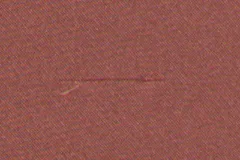 Weft defect (broken pick)
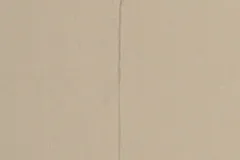 Warp defect (missing end)
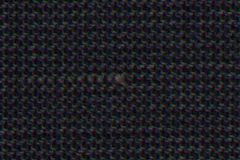 Slub
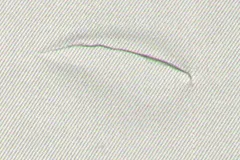 Float
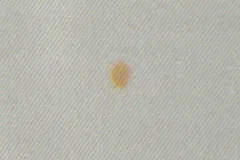 Stain
- Simulated imageShade variation
- Simulated imageBow and skew
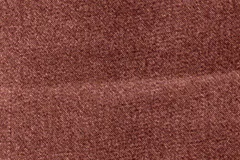 Weft bar
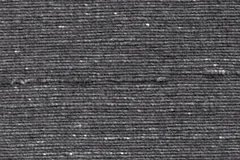 Thick thread
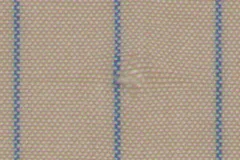 Knot
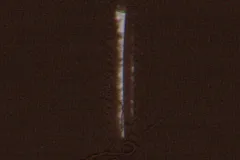 Hole
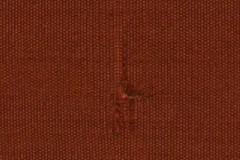 Ladder
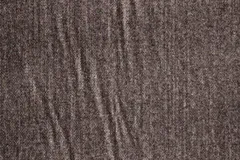 Permanent crease
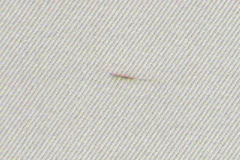 Foreign fibre (impurity)
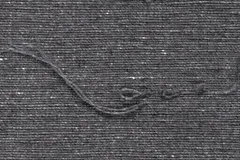 Flying threads
Photos: real defects captured by AQC’s vision system in visible light. Drawings are marked “Simulated image”.
- 4-point system
- The most widely used method for grading woven fabric, described in ASTM D5430. Each defect scores 1 to 4 points by length: up to 3 in (7.5 cm) 1 point, 3–6 in 2 points, 6–9 in 3 points, over 9 in (23 cm) 4 points; holes score 2 or 4. A roll is graded by its points per 100 square yards, against a limit agreed with the buyer.
- Anomaly detection
- An AI method that learns what good fabric looks like and flags areas that look different, without needing examples of every defect. Lucia, AQC’s AI assistant, uses it.
- Simulated imageBow and skew
- Distortions of the weft: bowed when the weft curves across the width, skewed when it runs at an angle instead of straight across.
- Defect map
- A record of every defect on a roll, with its type, size and position: in metres along the length and centimetres across the width. With AQC, each roll has its own defect map in Ariadne.
- Fabric inspection machine
- A machine that unrolls fabric over a lit inspection table at a controlled speed so an operator can check it for defects, then rolls it up again. AQC fits onto existing inspection machines.
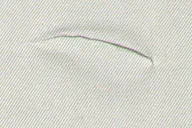 Float
- A yarn that skips over threads it should interlace with, leaving a loose strand on the surface.
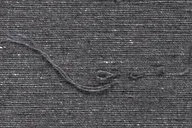 Flying threads
- Loose fibres or yarn ends caught on the surface of the fabric or woven in by mistake.
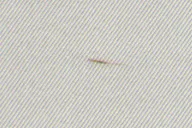 Foreign fibre (impurity)
- A fibre or particle of another material or colour caught in the yarn or the weave, such as a coloured fibre in a white fabric.
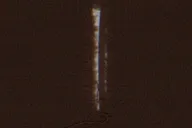 Hole
- An opening where yarns are broken or missing, often with frayed edges. In the 4-point system a hole scores 2 or 4 points, depending on its size.
- Infrared inspection
- Lighting the fabric with infrared as well as visible light. Some defects, hard to see in colour, stand out in infrared.
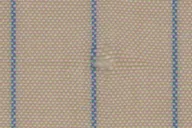 Knot
- The knot joining two yarn ends, woven into the fabric and standing out as a small lump.
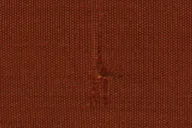 Ladder
- A short run of broken or missing yarns ending in a small hole, which opens like the rungs of a ladder along the length.
- Line-scan camera
- A camera that captures one line of pixels at a time. As the fabric moves, the lines build a continuous image of the whole roll, at constant resolution.
- Nesting (marker making)
- Arranging pattern pieces on the fabric before cutting to use as little fabric as possible. With a defect map, pieces can be placed around the defects.
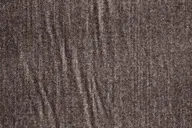 Permanent crease
- A fold set into the fabric during finishing, dyeing or rolling, which pressing does not remove.
- Quality-control centre
- An independent laboratory or service that inspects fabric on behalf of mills and brands and issues a report for each roll.
- Roll quality report
- The summary of one roll’s inspection: declared and measured length and width, defects by class and position, and a grade such as a 4-point score.
- Second choice
- Fabric or garments downgraded because of defects and sold or used at a lower value.
- Selvedge
- The self-finished edge running along both sides of a woven fabric. AQC prints a QR label for the selvedge so the defect map can be opened from the roll itself.
- Simulated imageShade variation
- A difference in colour within a roll (edge to centre, start to end) or between rolls of the same lot.
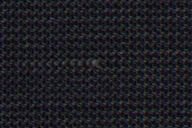 Slub
- A thick place in a yarn, woven into the fabric as a short, raised bump.
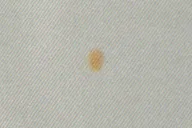 Stain
- A mark of oil, dirt, dye or another substance on the fabric.
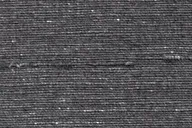 Thick thread
- A length of yarn thicker than the rest, woven in as a raised line across or along the fabric.
- Usable width
- The width of a fabric that can be cut into pieces, without the selvedges.
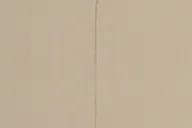 Warp defect (missing end)
- A fault in the yarns that run along the fabric, such as a missing or broken end. It shows as a line along the length.
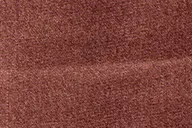 Weft bar
- A band across the width that looks lighter or darker than the fabric around it, caused by a change of weft yarn, tension or pick density.
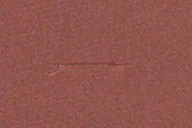 Weft defect (broken pick)
- A fault in the yarns that run across the fabric, such as a missing, broken or double pick. It shows as a line across the width.
See it on your own fabric.
Tell us what you inspect today. We will show you AQC on fabrics like yours.